

We had our friendly ongoing debate for almost a year. What happened to all those Hungarian Jews during World War II? Who did what? And who, if anyone, is responsible?
One thing we do know: Somehow, 600,000 Hungarians, who happened to be Jewish, were removed from their country in a relatively short period of time toward the end of the war and murdered. We go back and forth during the 10-months. What role did the Germans play? How much of the accounting, removal, and abduction of Jewish property, was conducted by Hungarians?
My Hungarian colleague looks at me. Maybe she’s read my posts. She sees an older American English teacher who happens to be Jewish and perhaps leans a bit too strongly into this topic: Hungary and its Jews. After all, Hungary was once a popular home for Jews. Budapest was more than 20% Jewish in the decades prior to the second world war. It’s leading universities enrolled more than 30% Jewish students. Neighborhood synagogues were everywhere. Today, you can see former synagogues being used as sports training centers, some lay vacant, a number are still fairly active, but quiet. Some Hungarian Jews don’t even know they are Jewish. For others, there are only distant memories and stories. There is, of course, some denial. “Are you Jewish?,” I occasionally ask Hungarians here and there. “Well, sort of,” or “It’s a long story.”
Please show everyone how happily Jews can live in Hungary
I thought our ongoing dialogue had reached its end–I am leaving Hungary after completing my teaching contract here…But, she offers one last exchange via email:
“This is my last present to you. My husband was shopping in the Central Market the other day, and he took notice of this elderly Jewish man walking home from the same place peacefully, really unnoticed. (Could he be an orthodox rabbi?) However, he took the opportunity to take some pictures of him, so you can show everyone in the US how happily Jews can live in this country.”
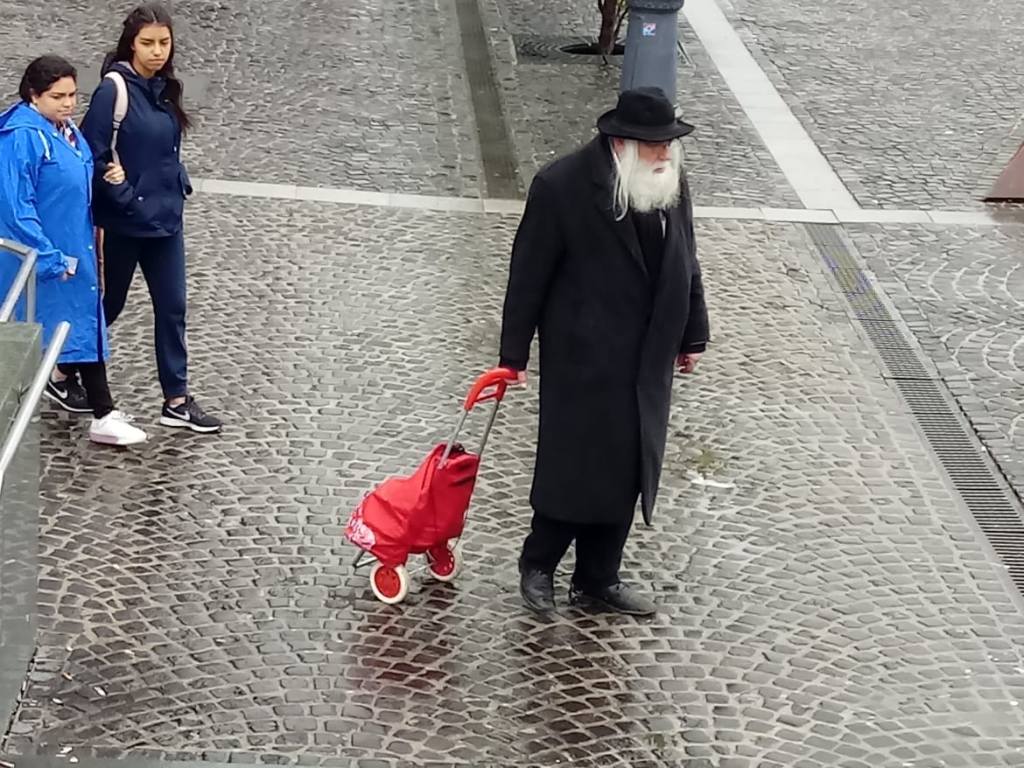
After reading her note, I put my heavy heart aside for a few days. My Hungarian friend genuinely thinks that spotting an old Orthodox Jew walking the streets of Budapest is proof that Jews live happily here. I should, she suggests, show this photo to everyone in the U.S. as evidence.
Though I am not Hungarian, I know this man. I know his story
I write back:
“These photos are truly beautiful, especially when I slowed down and took a few minutes to appreciate them. Please thank your husband for me. Ironically, I am sitting in a coffee shop directly across the street from the Dohany Synagogue as I write this. My wife and two American friends are visiting the Synagogue right now.
I hope your assumptions about how the other people view this Orthodox Jew are as positive, if not innocuous, as you suggest. In all likelihood, however, given the actual history here, most of this man’s older family members were killed during WWII. It’s quite likely his grandparents, one or both of his parents, older brothers and sisters, aunts or uncles, were amongst the 600,000 Jews killed here in Hungary. Perhaps he’s even reflecting on their lives as he’s walking along this street today.
You are lucky. You are privileged to be able to view these photos and make positive attributions about him and his life. Though I am not Hungarian, I know this man. I know his story. It’s the same story of so many of my family members, and friends’ family members who lived across Europe for centuries.
This truly was a lovely gift from you and your husband. My gift back to you is one of humility. It is true this man walks safely today on the streets of Budapest. But please don’t make too many assumptions about the difficult journey he’s had to endure to get here on this day. Best always,
Steve
The holocaust was a horrific travesty, but it wasn’t an accident. “Accidents,” they say, “do happen.” They continue to occur every time we deny what is real.

