

Helping Students Step-out of Their “Comfort Zones”
My former Hungarian high school student, Kristof, had it in his sights all along. He said he wanted to study abroad, somewhere in Europe, ever since I knew him as a 9th grader. Recently, he wrote me from his university in Sweden, “Steve, I am way out of my comfort zone and I am learning so much.”
Most of us know intuitively that risk-taking is an important skill. It can be an asset for almost anyone: students, teachers, managers, you and me. But that doesn’t make sticking one’s neck out any easier. And what about risk-taking that goes too far, and ends up endangering someone?
I was assigned to teach my senior Hungarian high school students a class on How to Find a Job. It was to cover the full panoply of tools and techniques including: conducting a skill assessment, writing a resume, navigating the job interview, and being able to give a convincing elevator speech in 90-seconds. It soon became apparent that many, if not most, of my students were completely uncomfortable doing these things. This was, after all, quite likely, the first time they were tackling these matters. Meeting some “big shot” in an elevator and describing in about a minute why they should meet with you would make almost anyone try to avoid that situation.
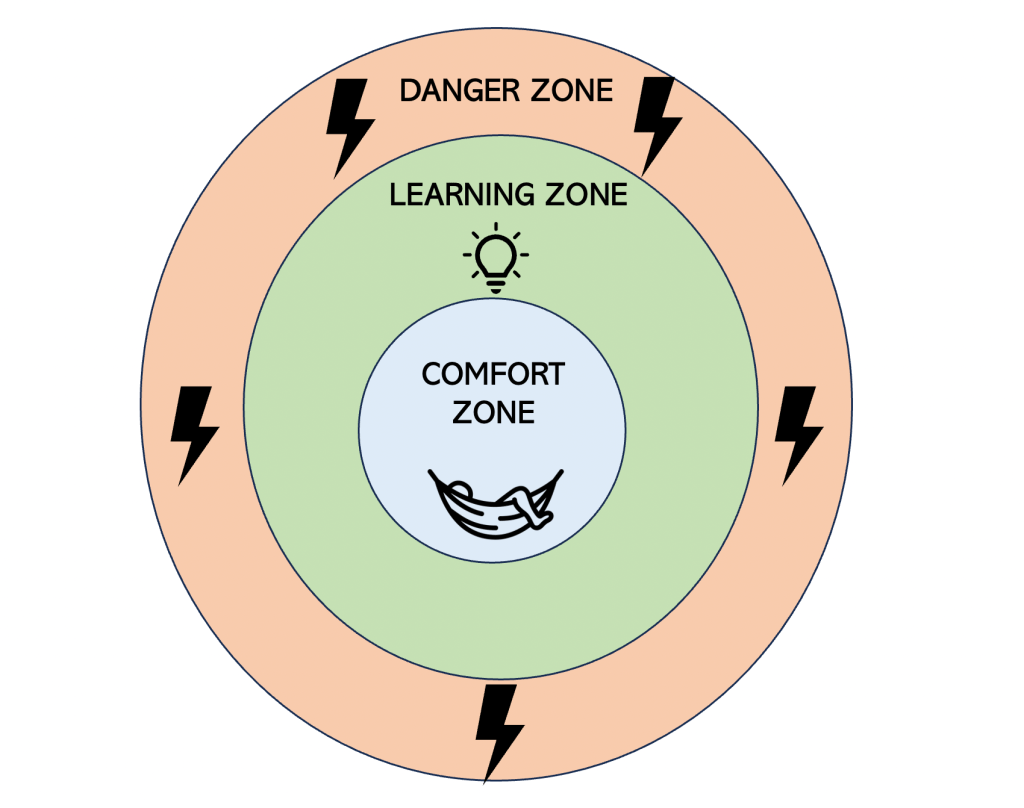
I decided to devote a full class to introducing a model I had used with managers years earlier. In the high-tech sector, technical employees are often promoted into supervisory roles, not for their managerial capabilities, but for their technical knowledge. “You know the technical stuff, you’ll make a great manager,” goes the thinking–albeit illogical. As a result, many of my clients felt completely unprepared to manage others, as they confronted their new role that included delegating, giving feedback, and solving people problems. As technical experts, they had excelled doing what they loved–solving technical problems. Now, they were being asked to refrain from solving technical problems and expected to solve problems involving people, teams, conflicts, and performance issues. Often, they were understandably completely out of their comfort zones.
The Comfort Zone Model gave us a vehicle for discussing the feelings and fears they were experiencing. Each day they arrived at work they were being asked to step outside the role that had made them successful–to let go of their familiar and comfortable technical expert role and manage a group of technical staff, many of whom, just days ago, were their colleagues. The model suggested that this new role required them to step into their learning zone-a challenging place for sure, but one filled with opportunities to learn new skills and to expand their confidence while helping the organization.
Fast forward to my Hungarian students. In teaching them the same model, they were presented a framework to help them understand that their discomfort was normal, predictable, and was a kind of experiential ladder for learning new skills and behaviors, a set of challenges that were going to help position them to get the internship or part-time job they wanted.
Last week, a Hungarian teaching colleague mentioned that “According to recent research, (only) 6 out of 100 young people said that they imagine their future in Hungary.” Think about it. My colleague understandably found that statistic to be truly sad, if not shocking. Yet, for countless reasons, most will not leave Hungary. Surely one fundamental reason is the mountain of personal mettle it takes to step out of one’s comfort zone: leaving one’s home, family and friends, perhaps having to learn a new language, and living in a foreign culture.
Meanwhile, my former student, Kristof, is doing all that and more in Sweden. By being willing to step out of his comfort zone, he is expanding his learning zone, and his life, for sure, will never be quite the same…
…While walking around our wintry island recently, a neighbor out with her dog, stopped to chat momentarily. “I see you guys are still traveling,” she said. “I’d love to do more traveling,” she continued, “but my husband won’t even leave the island.” For him, apparently, his comfort zone is where he wants to be. Her adventures now lie dormant and circumscribed by her husband’s unwillingness, or inability, to step out of his comfort zone.
I toast my student, Kristof, and all the risk-takers.
 American in Budapest
One response to “Risk-Taking in the ESL Classroom”
As always, I enjoyed reading your blog. This one hit me personally, as I recently stepped out of my comfort zone to embark on a new line of work that commences in May. My hat’s off to Kristof. He will do well in life, like you.
LikeLike