

It’s rather unmistakable. The first time we lived here in Budapest we both noticed it. We felt it at work, in shops, nearly everywhere we went in Hungary. After several weeks, we came to an explicit agreement–we would not let the palpable, dour spirit become part of our souls. This would take some work.
There’s a unique national malaise that plagues Hungary — one that most of Central and Eastern Europe has transitioned from — a culture of pessimism, characterized by a kind of sadness. Its conspicuousness is self-evident, but especially stands out when you travel to nearby countries such as Slovakia, Slovenia and Croatia. In general, the people there are friendlier, seem happier and you find yourself on the receiving-end of more smiles from the locals.

Last week I went to our neighborhood public health center to renew a prescription. The office was scheduled to open at 8:30AM. I arrived 2-3 minutes early. The doctor’s assistant, whom I’ve met about a half-dozen times before, opened the office door and yelled at both me and a young Hungarian guy also waiting to see his doctor. “Wait here,” he told me she had said. Fine. Then she asked what I wanted. I told her I needed to renew a prescription, showed the empty box from my last visit, and handed her my Hungarian health card. She told us to enter. We both sat in the waiting area. I turned to the Hungarian gentleman, half trying to assess how well he spoke English and said, “She’s unbelievable. Sometimes she amazingly friendly, and other times, she’ll just bite your face off.” “Hungarians,” he said with a wry smile.
Frankly, if this was a one-off, I wouldn’t be here writing this post. But, this is actually the norm in Hungary. I asked the handsome Hungarian what this was all about, half anticipating what he would say. “It’s about the wars and all the losing,” he answered.
This is, in fact, the unofficial national consensus–that Hungary, once the hyphenated partner in the Austrian-Hungarian Empire, the world’s greatest power at the time, had been so humiliated, so decapitated by the peace treaty after losing World War I, including the loss of 70% of their territory, that Hungarians are still angry. Add on the frustration of not having access to the sea, being yet again on the losing side during World War II, then being occupied by the Russians until 1991, and you’ve got a real recipe for a national diagnosis of sadness and depression. It’s quite real.
And having the hard-right leaning, authoritarian Prime Minister, Viktor Orban, hell-bent on grabbing as much money from the national coffers as possible, doesn’t much help create conditions for hope. Orban’s network of family and cronies, infamously travel around the country finding successful businesses and make offers that business owners “can’t refuse.” To do so, means you could end up in prison on trumped-up charges of tax evasion. As a result, there’s a strange pall over Hungary’s version of capitalism here: Be careful–if you are too successful, someone from the government will come your way and demand your business for themselves.
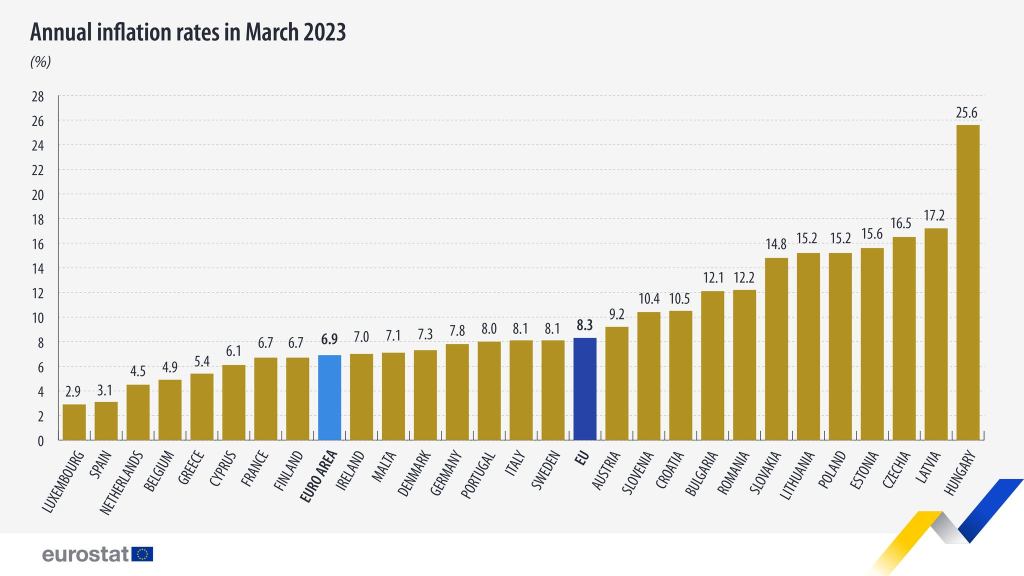
But perhaps you’re wondering about the government’s competence? An expat, like me, can cavalierly say, “Not my problem.” But if you’re an average Hungarian, the current state of the economy is a very real day-to-day struggle. Inflation is taking its toll on the Hungarian people. The annual inflation rate as of March 2023, was over 25%–the worst in Europe.
Given my previous experience both living and working in South Korea, I sometimes use that country for comparisons. Both Hungary and South Korea are similar in land size. South Korea is a peninsula, so its access to the sea is universal. While Hungary, as a result of treaty concessions, is landlocked, with the Danube River eventually granting access to the sea. But Korea, both what today is North and South, was nearly totally destroyed after the Korean War (1950-1953). I recall still seeing the after- effects as an expat there during 1973 – 1975. The hillsides, clear across the country, were starkly barren — barely a tree remained from the carnage. Few buildings remained undestroyed. Yet today, after generations of hard work, Koreans have built their economy into the world’s twelfth-strongest. Could Hungary pull-off their own economic miracle?
I believe so. Its juxtaposition in Central Europe is certainly an asset. So is its highly educated population, not to mention its incredible history of inventions and discoveries. But a democracy and effective leadership will be required to galvanize the population, including many naysayers. Hungary won’t get there by complaining about its past, and crying one-thousand tears.
 American in Budapest
One response to “Two-Years and a Thousand Tears”
I always enjoy your insights and perspectives on life, whether here in the good ole USA, maybe not so good anymore, or Korea or Hungary. This is a theme you have shared since your first days in Hungary. It’s sad and concerning on a national and international basis. The leader in Hungary is scary, as was our previous leader, and our potential future leader, be itTrump or DeSantis. Let’s face it, the world is a mess. As a relatively new grandparent, I worry about his future. However, worrying never changes anything. Hopefully, new leadership in our country and in Hungary, and eventually in Russia and China to name just a few, can put this world on a better path. Thanks for your writings. You’re very good at it.
LikeLiked by 1 person