


The memories of the the Jews of Szentendre are like notes left in the Wailing Wall in Jerusalem – messages periodically collected by the Rabbis and buried in the hills of the Olive Mount, so as not to be forgotten in the memory of God.
The earliest mention of Jewish people in Szentendre was about 1822, but like almost all of Hungary, that cord was ultimately and fatally cut in 1944 when Hungarian Jews were taken from their homes, moved into ghettos, and ultimately delivered to German death camps, Auschwitz-Birkenau, in particular. Today, the Jewish community, in this small, tourist and artist-centered town, has all but disappeared, save perhaps a dozen or so people. A tiny, mostly symbolic synagogue, with a capacity of about 5 or 6 people, has been created on private property along a quiet lane. When we visited it in the fall, it had recently been vandalized. Vandalization is an apt term to describe much of the Jewish history here in Hungary – the act of deliberately destroying or damaging public or private property.

It was in that little synagogue where I met Ingrid, a local Jewish woman of about fifty. She is a docent there. One thing led to another, and a story emerged – a story about a Math prize, a school, a boy and ultimately, a note to God…
Ingrid described the now quiet and largely hidden life of the few remaining Szentendre Jews. On religious holidays, she travels the 20-30 miles to Budapest. It’s only a small inconvenience. There, she can practice her faith and remain anonymous. During one such service several years ago, Ingrid noticed a woman sitting a few rows away and thought she looked familiar. Later, she approached the woman and introduced herself only to learn she was her son’s math teacher back in Szentendre. Hearing that the teacher was also Jewish was, of course, a complete surprise. They agreed to grab a coffee. It was there that the teacher shared a secret – one that she asked Ingrid to keep in confidence, to share with no one else. She lowered her voice and told her that her son had recently come in first in a school math competition…
…In his Nobel Prize winning novel, Fateless, Hungarian author, Imre Kertsez, describes, in a moving passage, his arrival back in Budapest after surviving the World War II death camps as a teenage boy. He returns to his neighborhood, and his apartment building, expecting to find his parents in their flat after years of somehow avoiding the gas chambers. “On reaching the 2nd floor,” he wrote, “I rang the bell at the door. It soon opened, but only as far as an inner lock, the chain of one of the safety bolts allowed, which slightly surprised me as I had no recollection of any such device from before. The face peering at me from the chink in the door, the yellow, boney face of a middle-aged woman, was also new to me. She asked who I was looking for and I told her this was where I lived. ‘No,’ she said, ‘we live here,’ and would have shut the door at that, except my foot was preventing her.”
…The top Math Prize, the teacher reluctantly continued with sadness in her voice, would not be awarded to her son. A school administrator had told her that they didn’t want a Jew to be given the highest award. She had relented to the pressure, she said, but wanted Ingrid to know about her son’s accomplishment. I asked Ingrid if she pushed-back and fought for her son’s rightful prize. “No,” she said, “we’re a small minority here. It’s not worth it.” Today her son continues his studies at a university in Florida.
The door opens, and yet, what we find waiting on the other side, may disappoint. We can, however, place a note in the wall. Its message speaks about the accomplishment of a young boy in a small town in Hungary. That story, and countless others, over the centuries, lay buried in the hills wherever the Jewish people have called home.
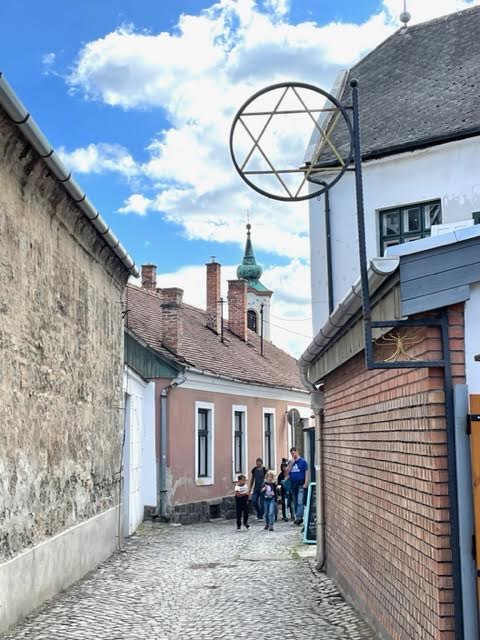
synagogue is located
 American in Budapest
4 responses to “The Math Prize”
Beautifully written and so sad. Being on this journey with you is an unforgettable experience. Thanks for continuing to share your perspectives.
LikeLiked by 2 people
As always, well-written, interesting, and insightful. This post also moved me. I’m sad and angry that a young Jewish boy, and it’s not limited to boys or Hungarians, can’t be rewarded for his accomplishments because of his faith, and instead must hide behind a closed door. We still live in such a shameful world.
LikeLiked by 1 person
As always, a beautifully written reflections on place and affect, both contemporary and universal.
LikeLiked by 1 person
As always, a beautifully written election on place and human affect both exceptionally personal and universal.
LikeLiked by 1 person