

“The problem is not just those who hate, it’s those who stand by complicitly, and do nothing.”
Eddie Gloude, Princeton University
What would I have done? What would you have done? Fair questions indeed. Some, no doubt, must have left proudly, though certainly indignantly. Others must have resisted, leaving their nail marks on the doors of their flats, then along the cement floors of their courtyards as they were dragged from their homes. Some perhaps went quietly. Some must have been screaming; the sounds reverberating off the walls of their apartment building. What, I often wonder, did their neighbors do? What were they thinking as they watched? What did the mothers tell their curious children as their Jewish neighbors were taken away?
During the last few months of World War II, Adolf Eichmann organized a trainload of Nazi accountants and came down to Budapest to address the “Jewish Problem” in Hungary. At that time, many Hungarian cities had double-digit Jewish populations. Just prior to the Second World War, for example, Budapest was more than 20% Jewish. Many leading Hungarian universities had Jewish student enrollments of 30% or higher. Eichmann’s 1944 initiative ensured that Hungary’s Jews were rounded up and shipped by train, or force-marched, out of the country. Many died en route to, or soon after arriving at, concentration camps in Austria and Germany.
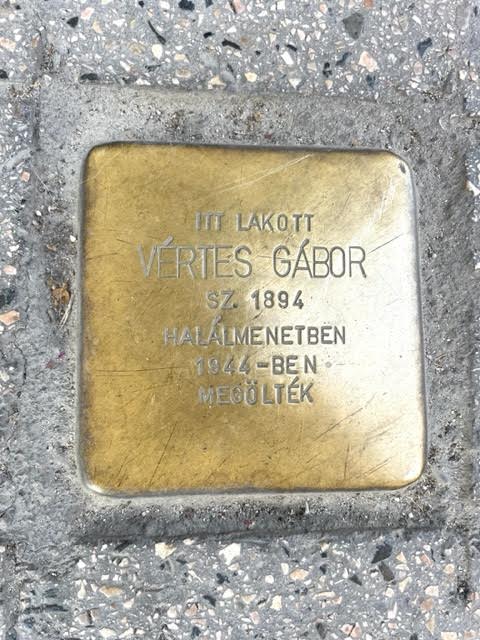
In remembrance of this blight on human history, a continuing and ever expanding memorial began in Germany in 1992 by artist Gunter Demnig. Stumblestones, or Stoplerstein in German, are tiny brass memorials which can be found by the thousands throughout Europe and Russia. Many dot the sidewalks of Budapest and other Hungarian cities.
The very few who survived the concentration camps returned home only to confront even more existential challenges. One fifteen-year old arrived back in Budapest to the old smell he knew so well in the entrance hall of his building. He was greeted by the familiar decrepit cage elevator and well-worn yellow stairs. But when he knocked on the door of his flat, expecting to see his family, a strange face came to the door. A woman asked, “Who are you looking for?” The gaunt, pale boy told her, “This is where I lived.” “No,” she said. “We live here now,” and shut the door…
This is the tale told by the Hungarian author, Imre Kertesz, himself a 16-year old concentration camp survivor in 1945. For his moving 1975 masterpiece, Fateless, and other books about the human struggle, he earned Hungary’s first Nobel Prize for Literature in 2002.
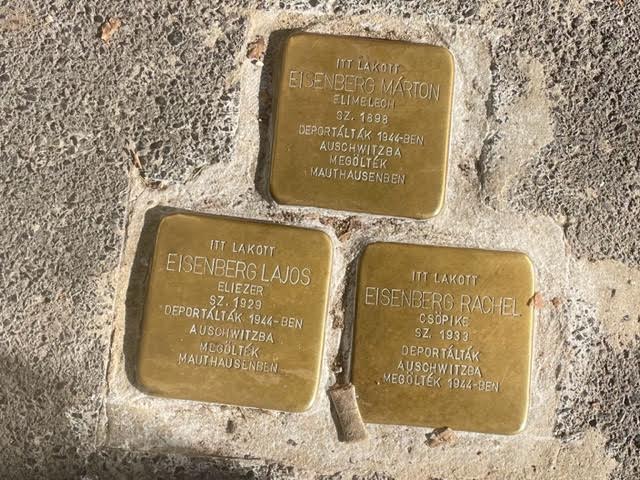
It’s easy, of course, to miss these sidewalk memorials around Budapest. The old buildings here, most from the Golden era of the 1890s-1920s, are so beautifully captivating, one is forever looking up in amazement. But they wait patiently for your acknowledging glance underfoot.


The American singer-songwriter, David Crosby, a powerful voice of his generation, died recently. In his song, Long Time Gone, he wrote plaintively, “Speak out, you got to speak out against the madness. You got to speak your mind, if you dare.”
If we dare.
 American in Budapest
One response to “If We Dare”
For Jewish people, the presence of extremist governments, like in Hungary and our own previous administration, will always conjure up memories of the Holocaust and frighten us with the prospect of rising anti-Semitism. We must never forget! Thank you Steve. As always, well written and illustrated. David Crosby!s resonant tones and amazing harmonies will always be playing in my head.
LikeLiked by 1 person