

He greets me many school mornings, hand outstretched, a smile on his face. I didn’t know his role at the school and frankly it didn’t matter. His is a friendly and calming countenance, a momentary oasis, in an environ-ment of noise and commotion–a typical Hungarian high school.
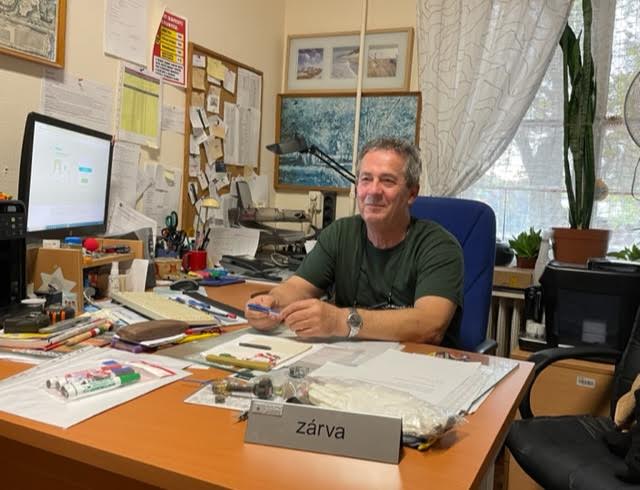
One day I asked him what he did before working here at the school. “The Navy,” he said being a man of few English words. The navy? That sent me up the stairs with my mind in a twist. I didn’t think Hungary, a landlocked country in Central Europe, had a navy. Well, they did once, when part of the Austro-Hungarian empire, well over a hundred years ago.
I concocted a plan to get to the heart of this perplexing story. I asked a few students of mine if they would schedule time to join me for a meeting with Joseph to sort this out. They would be my able translators and help me figure out Joseph’s story.
Weeks later, the four of us met in Joseph’s school office: me, Joseph, Peter and Kristof–the latter two, enthusiastic 12th graders I’ve known since they were my students in the 9th grade. The office is rather impressive–like no other I’ve seen in the school: a comfortable large sofa, a wooden desk, books and signs, countless paraphernalia–quite like a well worn smoking room in a countryside mansion. And, oh yes, a name plate on his desk with the word “closed” on it. Joseph apparently is the administrative head of the building maintenance staff and he wears his leadership role quite well.
With the help of my students, I used a battery of questions to get the story. Joseph’s career was as a free-lance merchant mariner. He operated out of Budapest aboard countless cargo ships meandering down the Danube to the Black Sea, Turkey and beyond. He proudly told stories about visiting Europe, Africa and Asia. One of his favorite stops was in Alexandria, Egypt, in 1979, where he sold a stash of cigarettes and hauled in some extra cash. Joseph’s love for the sea started as a little boy in the small Hungarian town of Kiskoros, an hour or so south of Budapest. He found his way to the only school in Hungary that taught boat-building as part of its curriculum. “I always work with passion,” he said. “I have unforgettable memories, that no one can steal.”
We ended our interview with a round of handshakes. I came to understand how Joseph had indeed spent his career on the high seas–not in the Navy, per se, but in the Merchant Marines. My students and I stood outside for a few moments trying to reflect on what had transpired during the last few hours.
Peter, looked at me and smiled. “Steve, he said, “do you remember that lesson you taught us four-years ago?” “Which lesson?” I asked. “The one about stepping out of your comfort-zone.” “Well,” he continued, “we just stepped completely out of our comfort zones just then. You asked us to be your translators and it was our first time doing this. I was a bit scared and uncomfortable, but decided to just go ahead and try it. It was a great experience–one I won’t forget.”
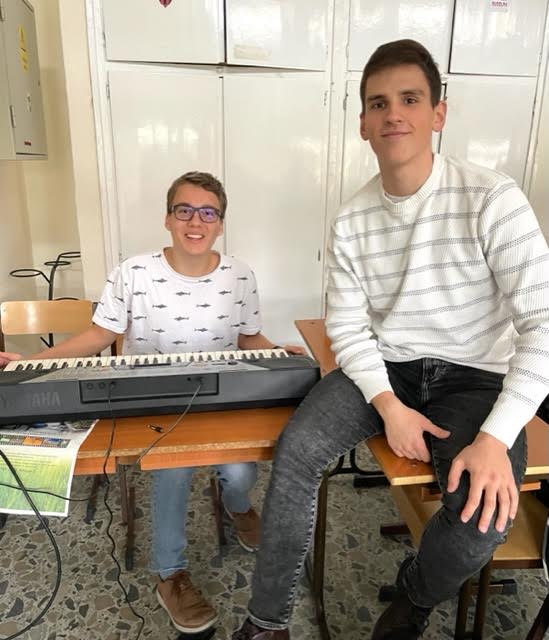
and Peter
I was so focused on sorting out Joseph’s story, I never even considered what might be going on for my students. It seems Joseph’s real gift was the one he gave to my students that afternoon–a chance to sail out from their comfort zones into a sea of learning and budding confidence.
 American in Budapest
2 responses to “Joseph’s Gift”
Wonderful story all around – great for the students, the teacher, and Joseph as well.
LikeLike
I totally enjoyed Joseph’s story and the lesson learned by Kristof and Peter. Joseph left his mark on the three of you, but only happened because you left your mark on your students. This comes as no surprise to me. Keep up the good work, Steve. Perhaps the pianist can play for you.
LikeLike